Monday, June 16, 2014

Good times Helsinki

With Maya at Maya Latin American Bar & Grill
Due to the tense political situation in and around Russia, Dave and I decided to meet my parents in Helsinki, Finland this year. A brisk two-hour ride on the high speed rail conveniently connects Helsinki to St. Petersburg. Alternatively, it takes about five to six hours to traverse the distance by car. Dave and I flew to Helsinki from Marburg (via Frankfurt airport), while my parents with my aunt Maya rode the train.

The geographical proximity makes Finland the number one tourist and transit destination for St. Petersburgians. Finnish visas are fairly easy to get, and many Russians come here to shop, to ski and vacation on various nature resorts, to take budget flights to destinations elsewhere in Europe and around the world. Once Dave and I announced our travel plans to friends and family members in Russia, several found they could join us here for anywhere from a few hours to a couple of days. Another considerable attraction of Helsinki as a meeting point was that our friends Olga and Ron live here, and having passed an unforgettable New Year's Eve together, we looked forward to spending more time with them this summer. They helped us a great deal with making complex hotel arrangements and restaurant reservations for groups of fifteen to eighteen people.

Olga, Ron, Vadik, Lena, Tanya, and Vanya at Elite Restaurant
Family selfie :)
For nearly seven centuries Finland belonged to the Swedish Empire, from the 12th Century until 1809, when the Russian Empire won the war against the Swedes and took it over. After the Bolshevik revolution, Finland proclaimed its independence and managed to defend itself in the ensuing civil war. A considerable part of Finland's population is Swedish, and Swedish is considered a national language on par with Finnish. All the signs at museums and on maps are labeled in the two languages, and sometimes also in English and Russian. According to Ron, a Swedish-speaking Finn himself, the presence of Swedish is most felt in Helsinki: traditionally, Finns were an agrarian people who preferred to live off the land and the sea, and the Swedes and the Russians built forts and cities. In the past fifty or so years, the dynamic has changed, and today Helsinki's predominant population is Finnish.

Aunt Anya with tablet and lily pads

Dave blogs here about our experiences in Finland through its food culture.

With Lena, toasting Olga's birthday
Helsinki (Helsingfors in Swedish) itself is by far the largest city in Finland, with over 600,000 residents--similar to Frankfurt and a little smaller than San Francisco. It's located directly on the coast of the Baltic sea, though sheltered from the open waters by the massive archipelago of more than three hundred islands. Large cruise ships, ferry boats, pleasure and fishing craft, ice breakers come in directly to the city harbor. One of these days, if it stops raining for long enough, Dave and I are hoping to rent bicycles and ride along the coast--a journey that could last from a couple of hours to a few days and maybe weeks. On Sunday, in honor of Olga's birthday, we did have an opportunity to take a ferry ride to one of the islands for brunch at a newly opened restaurant. The Baltic is a famously moody sea. On the way back, a strong wave pushed our boat against the landing, and a low-hanging log cracked a window of the lower deck. Luckily, the window was made of safety glass and as it broke down into shards, the two women sitting beside it escaped unscathed, rescuing their bags and sodas (protected by lids) from under the glass. 

Thursday, June 12, 2014

Visiting Marburg University

Many towns have universities, Marburg is a university—or so according to one town slogan. Of 72,000 residents, 25,000 are students and additional 8,000 teach and work at the university. Philipps-Universität began as the first Protestant University in 1527, and over the centuries graduated a number of illustrious students. The most notable, perhaps, are brothers Grimm who studied philology here and collected tales from the local society women. In the 19th Century, the University boasted one of the most prestigious philosophy departments in Europe; T.S. Eliott, Ortega y Gasset, Boris Pasternak, and Hannah Arendt studied there. This particular bit of history brought Dave and me to Marburg for a few days. My novel-in-progress is set during the summer semester of 1912, just before Professor Hermann Cohen, the head of the philosophy department, retired.

The door of the Marburg's medieval
Rathaus opens automatically


If you thought you could simply waltz into this ancient university and be directed to its archives, you’re more or less right. Within an hour of arrival on campus, I held in my hands the microfilm of the local newspaper for the year 1912 and was able to scan in the pages I needed and save them to my USB card, all free of charge. No one had asked for any form of ID or even as much as my name. The miracle repeated later when I wished to browse the stacks of the Philosophy department library. The young man working there asked me to leave my backpack on the bench by the door and led me to the stacks, explaining their organization system: books were shelved according to the author’s date of birth and then alphabetized by the last name. Instantly I had access to the most obscure tomes that seemed impossible to locate from the US. As a reader who for years had been intimidated by Stanford’s and Berkeley’s library access policies, I nearly cried from happiness.

With equal ease I made appointments to speak with two university professors, a third was out of town but promised to answer my questions via email. One of the professors met me at a charming riverside café, Am Grün (On the Green), connected to a bookstore, Rote Stern (The Red Star). Unlike most cafés in Germany where it’s customary to pay for food and drink at the table, "kollektiv" Am Grün requested that customers paid for their purchases at the counter and stayed for as long as they liked: the cooperative disapproved of consumerism and didn’t want to force it on their guests. The professor led me to a terrace on the riverside, and as we talked, he drank black coffee and rolled cigarettes. A philosopher and a musician (he plays classical guitar), he combined the two in his work, writing extensively on the philosophy of music. He named a few people in the history of philosophy who played instruments and composed music, among them professor Hermann Cohen, who wrote pieces for piano and violin.
Beach bar
Students taking lunch break

The university blended with the town, and on nearly every block we encountered yet another administrative or academic building. The medieval castle, once the seat of the local princes, now housed the university’s ethnographic collection. Nearby a boxy building from the 1970s housed the physics department. The Old University, a 19th Century neo-Gothic building where Professor Cohen taught, now housed the theology department, and the adjacent 16th Century Dominican church, now Protestant, is still used for services and exhibit space. The main library and the humanities department stood across the river, in the buildings known colloquially as “the elephants’ legs” for their characteristic 1970s and 1980s plain functional architecture, odd-looking next to the medieval old town. The lower floors of these contemporary buildings, minimalistic in their design and smeared by angry and humorous graffiti, provided ample study benches and some plugs for the students’ laptops and phones; at lunchtime, a cafeteria truck stopped in front of the doors to offer coffee, sandwiches, and sweets. The upper floors were orderly and clean, the entrances to the hallways enclosed by doors, presumably locked in the evening.

Ice cream line

The students dominated the town’s social life. They boated on the river, studied by the riverside,picnicked and played badminton and Frisbee in the parks, practiced juggling and some kind of variation of skittles, relaxed at the beach-style bars on the river, ate at the cafés and ice cream shops (a couple on every block!), rode bicycles down every conceivable alley, shopped at the bookstores and at the grocery stores. Dave and I mixed in as much as we could (though we didn't eat at the Mensa, the student cafeteria, or sought out to the late night discos) and enjoyed a few days of perfect tranquility and intellectual and epicurean pursuits.

Tuesday, April 8, 2014

Interview on The Fidelio Podcast

http://fideliopodcast.libsyn.com/

Marie Ross, a Cologne-based clarinetist who specializes in early music and period instruments, recently started a podcast where she interviews artists working in different fields about their creative careers and inspiration. I know Marie from her days at San Francisco Conservatory of Music, and a few weeks ago she asked me to participate in her podcast. We had a great conversation, and now this interview is available on The Fidelio Podcast homepage and on iTunes. Check it out!

Wednesday, March 26, 2014

Medics solve "the pesky Jewish question"

On the sidelines of my novel research is also the history of the Jewish settlement in Moscow. Until the revolution of 1917, Jews had had very tenuous rights of residency in Russia's historical capital. In 1827, precisely seventy-two Jews resided in the city. Some restrictions were lifted during Alexander II's reign, in 1859, and by 1891 the number of Jews in Moscow reached approximately 35,000. Among them were notable merchants, the railroad barons and bankers Polyakovs, the tea magnate Vyssotsky, the founders of beer factory in Khamovniki; painters, including Boris Pasternak's father Leonid and the great landscape artist, Isaak Levitan; countless artisans, tradesmen, students, workers.

In 1881, Alexander II was assassinated by the members of Narodnaya Volya ("People's Will") party, and his son, Alexander III, upon succeeding to the throne, made a point of establishing many reactionary laws, aiming to curb the reforms his father had tried to introduce.

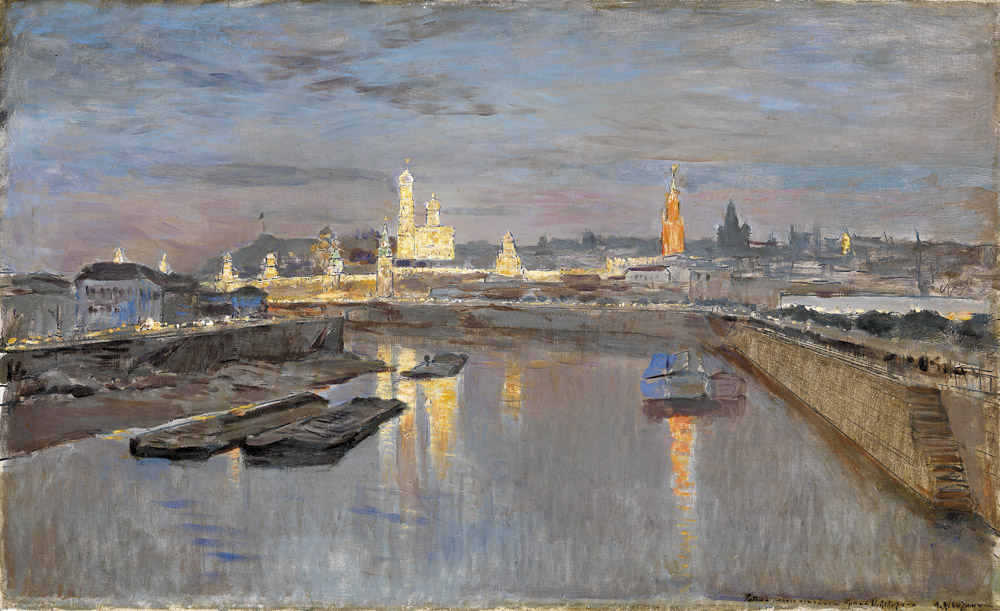
Isaak Levitan's "Illumination of the Moscow Kremlin
in the honor of Nicholas II"
In 1891, Alexander III appointed his brother Grand Duke Sergei Aleksandrovich to the governorship of Moscow. One of Grand Duke Sergei's first policies was to order removal from Moscow of all Jewish craftsmen, and later the order was expanded to include most categories of Moscow Jews, up to 20,000-30,000 people. (The statistics is a matter of some debate, since many Jews avoided official registration).

Samuel Vermel, a Moscow doctor and a Jewish community leader, left copious notes about the way the Grand Duke's order was executed, citing official documents and personal anecdotes. I'm translating two anecdotes from his notes, published in a volume "Евреи в Москве [Jews in Moscow]" (под редакцией Ю.Снопова и А.Клемперта, Москва: Мосты Культуры; Иерусалим: Гешарим, 2003). His writing style is at times effusive and passionate, with a heightened sense of tragedy (he compares the events in Moscow to the exile from Spain), but the details he provides are sharp and full of character.

The first story is a quick character sketch on the Grand Duke himself. "A Jewish electrician wired the Governor's mansion in Moscow. The job was performed handsomely and well. Grand Duke Sergei, inspecting the work in progress, expressed his pleasure. The electrician decided to speak up. "Your Imperial Highness," he said, "I'm not sure I'll be able to complete the work."

Grand Duke Sergei
"Why not?"

"I'm a Jew, and I stand to be exiled from Moscow."

The Grand Duke, embarrassed, quickly recovered, "So hurry up to make it on time," he said, and quickly left the room."

The second story is far more upbeat, though it dates from the year 1894, during the height of Grand Duke Sergei's campaign against the Moscow Jewish community.

Vermel writes, "In 1894, during the International Medical Congress in Rome, the president of the Russian delegation, surgeon Nikolai Vasilyevich Sklifosovsky, having secured the advance permission of the Russian government, asked to designate Moscow as the location of the next International Medical Congress. The French delegation accepted with delight, according to their temperament; the representatives of other countries were also glad of the opportunity to take a look at the "wild and barbarian Russia." Moscow's offer was accepted.

"The medical circles of Moscow began planning for this unprecedented event, excited to host the brightest stars of the medical science. But as the date of the Congress approached, "the Jewish question" unexpectedly entered the stage. As a matter of fact, Russian laws at the time prohibited all foreign Jews from entering the land. What to do? An International Medical Congress without the Jews was inconceivable. Jews were well represented in the medical profession, ranking high in quality and quantity, and included Cesare Lombroso [an Italian criminal psychiatrist], Hermann Senator [a German internist], Emanuel Mendel [a German neurologist and psychiatrist], Oscar Minkowski [remembered for his research on diabetes], Paul Ehrlich [an immunologist who later became a Nobel Laureate], among others.

"The German medics, of whom a particularly large number wished to go to Moscow, raised the question of passage to Moscow well ahead of time and demanded an unequivocal answer. The president of the German organizing committee, a world-renowned scholar and politician Rudolf Virchow ["the father of modern pathology"] demanded a clear-cut answer: yes or no.

The new University of Moscow and
the Moscow Clinique, images from The Lancet supplement,
printed for the Congress of 1897
"Grand Duke Sergei Aleksandrovich felt cornered and hesitated for a long time, refusing to commit one way or another. Sklifosovsky, at organizational meetings, exclaimed, "Ah, the pesky Jewish question!" The Grand Duke started haggling: he agreed to issue the foreign Jewish medics the permits to arrive and stay for two weeks. But Virchow decreed categorically: "If there will be any special conditions made for the Jews, no German medic will go to Moscow."

"And so Moscow authorities were forced to remove the Jewish question from the agenda and to establish "equal rights" between Jewish medics and medics of the other confessions.

"The Congress took place in August 1897; it was formally opened by the Grand Duke Sergei Aleksandrovich. It was one of the most spectacular and well attended International Medical Congresses, and Moscow saw within its walls a tremendous number of medical luminaries."

Tuesday, February 25, 2014

Natasha Klimova and her Letter Prior to an Execution

This story comes from the sidelines of the research for my novel-in-very-slow-progress. A friend lent me a book by Grigoriy Semyonovich Kan, published in St. Petersburg two years ago: Natalia Klimova. Her life and struggle [Кан, Г.С. Наталья Климова. Жизнь и борьба. С-Петербург, Издательство имени Н.И. Новикова, 2012]. I had but cursory familiarity with Klimova's name before I opened the book, and I read the volume 'with my mouth gaping,' as they say in Russian. Here's something between a brief summary and a review of this biography.
1903-1906

Klimova was born in Ryazan in 1885; her father, a lawyer, was an elected member of the representative council of small landowners (земское собрание)--Russian Empire's narrow concession to the idea of self-government. Her mother, Liubov Vyropaeva, came from the old Russian gentry and in 1870 became one of the first, if not the first, Russian woman to receive a medical degree--in Switzerland. She specialized in gynecology, established a respectable practice in Ryazan. She died in 1894, undergoing an operation for an ectopic pregnancy. A few years after her death, her husband and Natasha's father married Liubov's sister Olga, and so Natasha's aunt became her step-mother.

At first, Natasha tried to follow in her mother's footsteps. In 1903 she arrived to St. Petersburg and entered the women's higher education courses that would prepare her for the entrance exams to the Women's Medical Institute that by then existed in the capital. In 1904, Russia entered the war with Japan that seemed senseless to most young people, radicalizing many and leading to a renewed vigor in protests against the autocratic government--the protests that in 1905 erupted into general worker strikes and a large scale revolutionary movement, brutally broken up by Nicholas II's government and army. In December of that year, workers and students organized an armed protest in Moscow, and Klimova was among those who carried revolvers and ammunition to the barricade lines.

Klimova joined the Socialist Revolutionary party (illegal, as all socialist parties in Russia at that time), advocating for land reforms (transfer of land to the peasants) and self-government via a democratic election process. Her favorite reading at the time was Nietzsche and Tolstoy, a combination fairly typical to the disenfranchised young people of the rapidly industrializing Russia. According to Kan, from Tolstoy Klimova took the disgust with the existing class system, the wealthy "who feed on the poverty, debauchery, and suffering of millions."

Where Tolstoy rejected violence as the means of attaining social order, Nietzsche took over: "Humanity is what one must eclipse. . . . What matters in a human being is that he's a bridge, not the aim: one can only love the passage and the demise in a human being. . . . I love not those who look to the stars for the reasons to perish as victims, but those who actively bring the sacrifice of themselves to the earth, so that one day the earth can be the earth of the new man." [I'm translating this stuff from the Russian, trying to capture the style of the old-fashioned Russian translations of Nietzsche.]

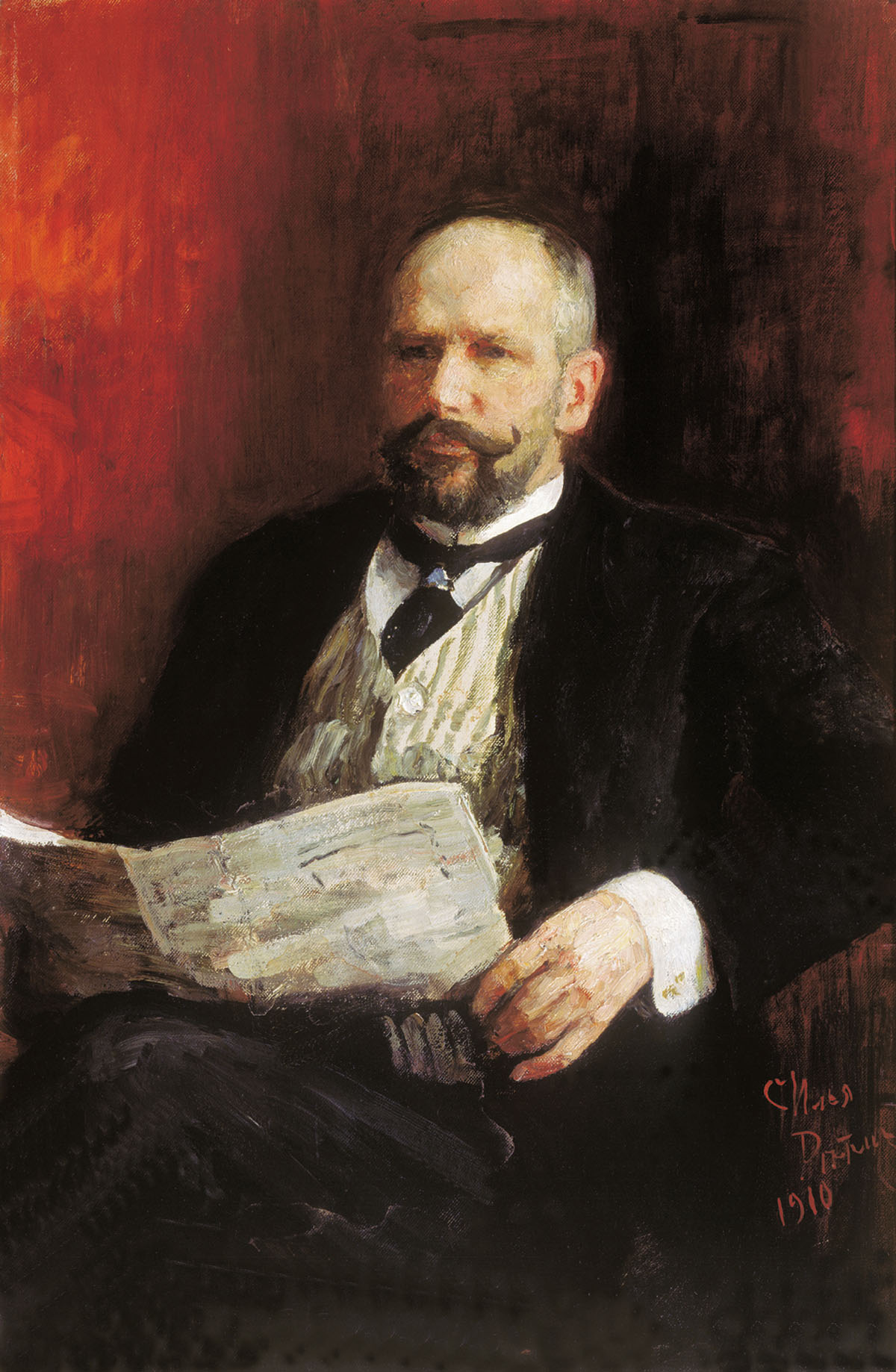
Stolypin, in Ilya Repin's rendering
So, Tolstoy and Nietzsche: an explosive combination of asceticism, ideas of equality and classless society, Pyotr Stolypin. Stolypin, Prime Minister of Nicholas II's government, today is often remembered as a reformer; in 1907 he was responsible for suppressing the revolution and for increasing the punishments for the revolutionaries. (His slogan, "Levelheadedness comes first, reforms second [Сначала успокоение, потом реформы]".) Carrying bombs, the terrorists entered Stolypin's dacha. Things didn't go as planned--Stolypin's security became alarmed, and the terrorists exploded the bombs too early. Twenty four (including the terrorists) died instantly, and sixty more were hurt; Stolypin himself was unharmed. Klimova was not on the premises during this action, but she'd been instrumental in transporting and storing the bombs. The vast  the surviving members of the terrorist organization, including Klimova, were arrested and tried. Stolypin didn't survive for very long: he died in 1911, in Kiev, at the hand of another terrorist.
with the hero worship and the challenge to stretch personal and social limits to achieve her goals. In 1906, Klimova joined a terrorist group who aimed to kill

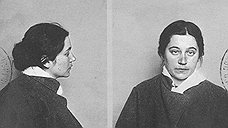
In St. Petersburg prison, 1908
Klimova was sentenced to death by hanging. A short while later, the sentence was commuted to imprisonment for life. While expecting her execution, she wrote a letter to her family that somehow made its way into print in a St. Petersburg journal. This letter, along with the other of her personal documents that survived the 20th C, is reprinted in the back of Kan's book. A unique and fascinating document, it's fairly abstract, perhaps too abstract to our contemporary tastes: she talks of fear of death, of what she believes might happen after her death: "I don't believe in any 'future lives.' . . . If the matter that my body's made of chooses to become the green grass of 1907, and its energy--the electricity that shines over Stolypin's cabinet, what have I to do with that?" She talks of life, of experiencing the heightened state of awareness on the brink of her death: "The dominant feeling is that of a special kind of inner freedom. It's--it's terribly difficult to explain. . . . In it, there's the pride of a person who has faced death and calmly and simply told her, 'I'm not afraid of you.'" Tolstoyan thought (Kan shows to what extent her thoughts on death were inspired by Tolstoy) acquires a whole new meaning under the pen of a twenty-one year old girl.

In another document, a memoir of being imprisoned in the famed Peter and Paul Fortress, Klimova writes: "I can't shake a very odd sensation. . . . It's as though I had not been taken here by force, but came here of my own free will, and that it's not a prison, but my own, ours, ancestral home. . . . How many [came before me]: the Decembrists, members of the Ishutin's circle, Nechaev circle, Narodovoltsi and their offshoots, the children of the present--the last links in the long-living chain."

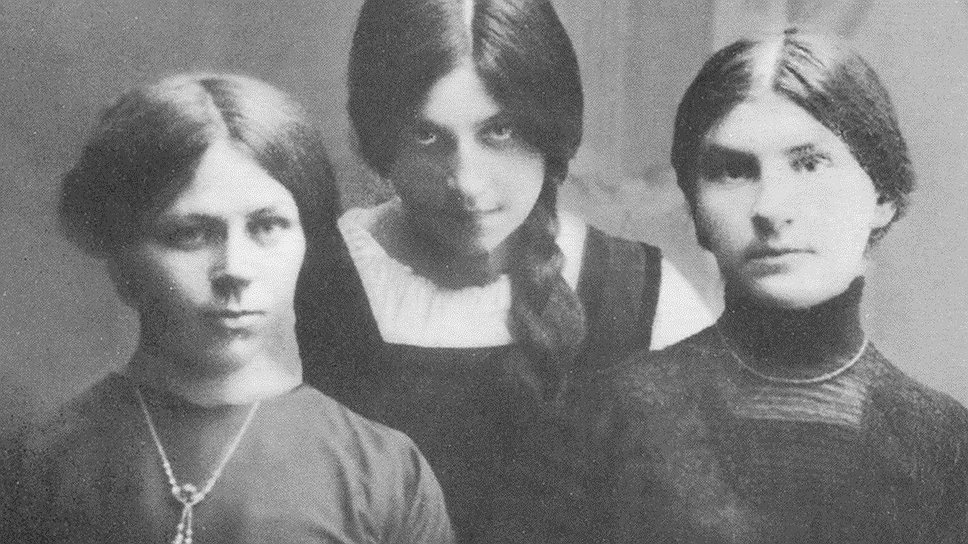
As I mentioned earlier, Klimova's sentence was commuted. In 1909, she and thirteen fellow female political
The woman on the left, Tarasova, was a prison guard who facilitated
Klimova's (in the middle) and Gelms's (on the right) escape
prisoners staged a daring escape from their Moscow prison. (Mayakovsky's mother sewed clothing for these women, helping to prepare their escape). Klimova took the Eastern route out of Russia, and traveled the Trans-Siberian railroad to China and then across the world to Paris, where she rejoined some of her comrades. Kan makes a good case showing that later in life she might've grown remorseful and troubled by the people that she and her comrades killed. Nevertheless, the matter of the revolution was pressing. She tried to stay involved in the terrorist organization. At the same time, she married and gave birth to three children. She died in 1918, having lived long enough to see the revolution she worked for go astray when Bolsheviks took over. Her eldest daughter, Natalia Stoliarova, reemigrated to the Soviet Union in 1930s, ended up in the Gulag, and later played a large role as the intermediary between USSR and the West, surreptitiously connecting Soviet artists and writers to the audience in the West. Her story deserves a separate narrative; it undercuts all familiar stereotypes of life in the Soviet Union.

Varlam Shalamov
The story of Klimova's life has inspired several "belles lettres" writers. Kan's volume is framed as a response and explication of Varlam Shalamov's documentary tale, "The Gold Medal." (Shalamov is best known for his Gulag narrative, Kolyma Tales.) She appears as a character in Solzhenytsin's August 1914 and Suicide by Mark Aldanov. Kan is meticulous in gathering all the memoirs and documentary sources that mention her name. 


One of the most appealing features of Kan's fascinating study is its incredibly thorough work with the sources: every factual statement is cited and, frequently, annotated, leaving the reader with a complex picture of the revolutionary movements of the early 20th C. If I had one criticism for Kan's approach it's that he makes a little too much of her relationships with the men in her life (and male influences), and while he does a great job of mentioning her relationships with notable women of the revolutionary movement and prominent cultural figures (Zinaida Gippius disliked her intensely), the descriptions of the women are almost always cursory. Many factors probably went into this; Klimova herself probably prioritized the men in her life over the women. I would love to know more about Klimova's mother, the first female Russian medic?? Kan's details about her are scant. I wonder how many documentary sources exist, and how much Klimova knew about her mother. Pulling this thread further would add another dimension to the book.

Sunday, February 9, 2014

"My Mother at the Shooting Range" in Tver


A theater troupe in Tver (one hundred miles northwest of Moscow, en route between Moscow and St. Petersburg) is staging several of my short stories from my second Russian book in a full theatrical production! Anyone wants to go to Tver next week?? The title story of the show is "My Mother at the Shooting Range," published a few years ago by J Journal: New Writing on Justice.

If you happen to be in or near Tver on February 15th, go to see the show: http://www.tverlib.ru/news14/0215.html

Saturday, January 25, 2014

S. Ansky and the Russian revolution

A few years ago, when I was taking a playwriting course at the Berkeley Rep theatre, I came across Tony Kushner's adaptation of "A Dybbuk," a play by S. Ansky, translated from Yiddish by Joachim Neugroschel and collected in a volume by Theatre Communications Group with afterword by Harold Bloom and a few other Jewish folk tales and tales by Ansky. The collection traced the motif of the dybbuk--a malicious soul of the dead capable of taking possession of somebody still living--from 19th Century Eastern European Jewish folklore to Ansky's popular piece of Yiddish theatre. Shortly after I read the book, brothers Coen released A Serious Man where a dybbuk vignette prefaces the main narrative: one of the most memorable recent adaptations of the motif.

The book introduced S. Ansky himself very briefly, describing him as a Yiddish author who wrote "not only realistic but also supernatural stories, for which he drew on the mystical tales handed down in Chasidic communities." (Harold Bloom's afterword was dedicated primarily to the discussion of Kushner's adaptation of Ansky's play.)
S. Ansky

Recently, reading up on the history of the Russian revolution, I came across Ansky's name. In brief: he was born Shloyme Rappoport in Belarus, a part of the Russian Empire. Though he received a traditional Jewish education in the yeshiva, as a seventeen-year old he broke with orthodox Judaism, learned Russian, and traveled around Jewish shtetls as a teacher providing secular knowledge. He became a passionate narodnik, trying to enlighten peasants (Jewish and Russian) to their own condition of serfdom and to incite social unrest at the "grass roots," as we put it today. He worked for several years in a coal mine near Dnepropetrovsk (today, a part of Ukraine), organizing readings among the miners and trying to convert them to the socialist cause. The miners were very mixed in their ethnic and religious origins: from Orthodox Russians, Ukrainians, and other to Lutheran Germans, Volga Muslims, Jews; all who failed to make a living on the surface. They gave Shloyme Rappoport a nickname: Semyon Akimovich.

Gleb Uspensky
He then started sending stories of mining life to a prominent socialist newspaper, and one of the editors noticed his gift for storytelling and advised him to take instruction with Gleb Uspensky, a notable Russian writer of socialist leanings. Viktor Chernov, later a leader of the Socialist Revolutionary party, relates a story of how Rappoport arrived to St. Petersburg. He had no place to stay and no papers (Jews at the time had to have a special permission to be allowed in the capital). Instantly upon arrival he went to party headquarters and sat in on a meeting, and after the meeting everyone went home but Rappoport was shy to admit he had nowhere to go. He spent the night walking the streets, afraid to sit down for the fear of being picked up by the police. Towards morning, Uspensky, returning from an all night dinner party, found him roaming the streets. The older man was touched by Rappoport's story and took him under his wing. He gave him a few pointers about the literary world and helped him come up with his pseudonym--S. An-sky.

Eventually, the socialist group sent An-sky to Paris, to work as a secretary to an older narodnik, Petr Lavrov. An-sky worked for him for six years, taking dictation of Lavrov's influential philosophical and political essays. Eventually An-sky started writing essays and fiction to explain the socialist ideas in the language that would appeal to peasants--that would inspire them and turn them to political action. That was a rare talent among the revolutionaries of the time, and An-sky quickly became an important figure in the socialist movement.

After the failure of the revolution of 1905, An-sky little by little turned his attention to the Jewish cause and organized the first ethnographic expedition to Jewish shtetls, describing the effects of pogroms on the communities, and also witnessing the practices of everyday life, recording folk tales and legends, oral histories. During the revolution of 1917, An-sky was elected to the Constituent Assembly as a member of the Socialist Revolutionary party--the democratically elected legislative body that was later dissolved by the Bolsheviks (under Lenin's leadership).

A fully bilingual author, An-sky seemed equally comfortable writing in Yiddish and Russian, though he rarely translated himself and didn't like doing so. There are several origin stories of "Dybbuk": he wrote the play in 1914, and at some point showed it (the Russian version) to Konstantin Stanislavsky at the Moscow Art Theatre who admired it and gave advise. The play received its premiere in 1920, after WWI and Bolshevik takeover--it was staged in Warsaw, in Yiddish by Vilna troupe--a few weeks after An-sky's death.

Leonid Pasternak's painting: S. An-sky reads "Dybbuk"

Sunday, January 5, 2014

Ramayana Matters

Our last three days in Bangkok were a flurry of activity. One of the highlights was a five-hour long bicycle tour through the busy markets and Buddhist temples, navigating through alleys so narrow and congested that had we wandered there on our own, we probably wouldn't have dared to venture in. Bangkok was introduced to us a city of marketplaces: weekend markets, night markets, floating markets (the Chao Phraya river used to be Bangkok's main trading artery), Chinatown markets, wholesale markets, flower markets, etc etc. Dave writes in greater detail about our bicycle adventures on his blog.
Wholesale flower market

Though Buddhism is Thailand's official religion, Thais also believe in spirits. Every other city intersection seemed to feature a spirit house, to which people brought daily offerings of flowers and food. Certain large trees were also decorated and worshipped; later we heard that every time a new house is built, a displaced spirit needs to be pacified by construction of a new shrine outside of the house's shadow. Garlands of yellow flowers are in such high demand that an entire section of the wholesale flower market was dedicated to their assembly and sales. Need to pass a test? Have bad fortune and want good fortune? These occasions undoubtedly call for extra offerings to the spirits.
Placating the tree spirit

The Wats themselves--the Buddhist temples--were plentiful and magnificent. It was not uncommon to see terrific poverty and squalor next to the tall white-washed walls and gold-plated doors of newly renovated temples: eerily similar to the experience of walking down Market Street in San Francisco, with all the new skyscrapers going up right above the homeless. We also walked through many neighborhoods of malls and hotels and office buildings and middle-class single-family Thai and Western-style style houses with garages and backyards. The different areas flowed easily into one another, extensive networks of alleys and courtyards dissecting each city block: to get a sense of each area, we quickly learned to go off map and follow our noses. Every populated alley and large intersection seemed to feature several food carts selling barbequed meats, noodle, rice, and egg dishes; carts offering instant coffee espressos (sugar and condensed milk optional); spirit temples; 7-11s. It seemed common for families to keep chickens and turkeys in their compounds. There were also many dogs and cats roaming around, none of them lacking for food: let's just say that Thai spirits were generous and ready to share.

A window of almost every store, restaurant, or semi-official establishment (including cabs and tuk-tuks) featured King Bhumibol (also known as King Rama IX) and/or other members of the royal family. Thailand is a constitutional monarchy, ranked currently 135 of 179 in the Reporters Without Borders Press Freedom index (somewhere between Afghanistan and Russia). A perceived criticism of the royal family is a punishable offense for both locals and foreigners alike. And who would want to criticize His Majesty? He's a very photogenic presence and a natural model--as evidenced by hundreds and thousands of images of him we've glimpsed during this trip--a photographer himself, and from what I understand a talented poet. And he takes after the best: in the late 1790s his ancestor King Rama I created Thailand's greatest epic, Ramakien, by compiling and rewriting certain episodes from the Hindu Ramayana. His son Rama II adapted the work further, apparently construing a happy ending. (The very name of Thai Kings, Rama, at least in English, comes from Ramayana, but this business is very complicated--as are Thai naming customs.)

This business of Ramayana/Ramakien gave me a great deal of hope: it instantly made Thai culture feel approachable. That is, I could simply read the Ramayana (with a great deal of footnotes) and then study the Ramakien, and this would give me far greater understanding of the Thai imagery and symbolism. As it was, Dave and I soon learned to spot references to these epics. The galleries of Wat Phra Kaew (the temple attached to the Grand Palace and housing the Emerald Buddha), for example, retold stories from Ramayana. And so did many paintings at the Contemporary Art Museum, MoCA Bangkok, one of the city's newest museums.

In every country we visit, Dave and I usually try to look up the contemporary art scene. Prior to this trip, we'd heard from my brother Kostya and Dave's colleague that Bangkok boasted a vibrant community of artists: a recent feature in the New York Times made this official. Vibrant art community there might be, but not at MoCA, Bangkok. Let's just say, I made a googling mistake. And from the photographs and the TripAdvisor page the building itself looked very respectable. Dave and I braved an hour and a half-long trip by two trains and a bus to the outskirts of the city--to find ourselves nearly the only visitors roaming the five floors of exhibit space. The art... well, it was very clean and featured many contemporary takes on Ramayana/Ramakien. Temporary exhibit #1 showed off His Majesty's own photography.
Best of MoCA: Dave with Dali wax sculpture
Actually learning to take the bus in Bangkok proved useful. The very next day, Dave and I got embroiled in another adventure. I suppose, if one were attributing blame for these things, one could say that I made another googling mistake. I looked for a good walking tour, and every walking tour I was finding seemed to be at least four or five hours long. Finally, I discovered the tour that claimed to take only two and a half hours and was free to boot (I assumed the guides operated on tips--we had taken a tour like this in Sydney). The webpage gave the time and location; so I figured we'd just show up. In the worst case scenario nobody would meet us, and we'd put together our own tour: we had the map and an idea about what major Wats and palaces we still had to see.

Dave wasn't feeling well that day. He'd caught a cold a couple of days earlier and was powering through it. A tuk-tuk delivered us from our hotel to the historical center. The day was particularly hot and humid, probably the hottest day of the trip so far. The location was a large park right outside the gates of the Grand Palace. The free tour guides were nowhere to be seen, though we combed the park back and forth in several directions. Dave approached a respectable-looking Thai gentleman carrying an orange umbrella and asked him if he might be a tour guide or if he'd seen any tour guides.

The man shook his head: he was a lawyer, teaching at the nearby law school. Where were we from? he asked. Oh, California. His uncle was in California, in Southern California. What did we want to see in Bangkok? Grand Palace and all the main Wats were closed this morning because of an important Buddhist ceremony, but he could point out some temples on our map that would be open and that we had better see. We'd have to go by tuk-tuk--these temples were further away. But we could get a "governmental" tuk-tuk, with white and yellow license places, and the whole route would cost us 40 Baht (a little over a dollar). There was also a great silk store on the way that was running a special promotion. The man raised his orange umbrella, and after a short while tuk-tuk materialized. We thanked our new friend and climbed aboard.

In fifteen minutes, the driver deposited us at a small temple outside the perimeter of the old city. We weren't entirely disoriented--we had a map and a working smartphone, and we'd spent several days roaming the city at that point, and had an idea of its geography and layout. There were no other visitors at this temple. The security guard seemed very curious--how did we hear about this Wat; most tourists don't know about it, though it's a very important Wat--one of the members of the royal family had been a monk there, and the family gave the money for the temple's upkeep. The story sounded familiar--I had read about a temple like that, and so Dave and I looked closer at the Buddha towering over us. The security guard was sweet and wanted to know how long we've been married--we must've been on our honeymoon... Then, he recommended a shop where we had to go after this Wat, a shop selling gems and jewels, rubies, sapphires, with a 600% discount.
Confused at a Wat
Dave, I think, was suspecting a scam from the moment we got into the tuk-tuk, and had he not been affected by the cold, he wouldn't have let things go this far. I refused to believe that we were being scammed--so elaborately and bizarrely--for as long as I could. But then when the tuk-tuk driver insisted on taking us to that store, I had to admit that we were being taken for a ride--that that's where the expression "being taken for a ride" probably came from.

Getting out of it all was awkward. We were in the middle of nowhere. The tuk-tuk driver had called all of his friends, and there were something like eight people meeting us at the gem store (to make the place look more popular, I suppose?). The idea was that we'd go inside and buy things. The scam was apparently so popular (and effective) that it was outlined, step-by-step, in all the tourist guide books we'd read. Still it was hard to believe how many people must've been involved. On the other hand, we decided, this was probably not that different from being talked into attending a time-share presentation in Las Vegas. In both cases we didn't actually have the money on us. In Bangkok, we were down to our last few hundred Baht, and we needed them to get to the airport later that evening. So we apologized to the tuk-tuk driver--we felt bad embarrassing him in front of all of his friends--and walked away.

We visited the Grand Palace and the Emerald Buddha--both sites turned out to be open. (It took us that entire day to unravel all the stories that the scam artists had told us about Bangkok--and I'm still not sure about some of them: do, for example, differently colored license plates on tuk-tuks mean governmental vs. private?). Getting out of the downtown area proved nearly impossible. With so many tourists needing a ride, the cabs refused to turn on the meter--they preferred to charge a flat fee for at least twice the amount what the meter would cost. Though in the US dollars the difference amounted to that between $4 and $8, not getting cheated became a matter of principle with us that afternoon. Armed with the smartphone, we could take a bus where we needed to go for less than a $1. Except we couldn't: in the mid-afternoon, the city suffocated with traffic, and the right bus never came.

None of this spoiled our mood one bit. We were having fun. Dave had sweated out some of the congestion in his chest. We bought a coconut and visited another museum that afternoon--Jim Thompson's House. Then Dave took a nap and I explored the Bangkok Art and Cultural Center, a proper contemporary art museum (also an art school and a shopping center for books and new age gifts), displaying very creative and high-tech works of art, integrating variety of media, engaging with artists around the world, and reflecting on contemporary social themes beyond the Ramayana/Ramakien.
Cutting the coconut
That night, after Dave woke up refreshed from his nap, we packed up our bags and headed out again to while away a few early morning hours till our 7 am flight. At 3 am we found ourselves at a supermarket in Patpong, shopping for Sriracha and tamarind snacks to take back to San Francisco as souvenirs. Then we took the metered taxi to the airport, and spent our last half hour before the flight at duty free shops, sampling the rice crackers these shops were promoting: all the same brand, but different flavors. (There must've been a dozen shops in a row running the same promotion--that's a scary amount of rice crackers.) We passed out the moment we got on the plane and slept all the way to our layover in Tokyo.
Round ping-pong table at Bangkok Art and Cultural Center

Thursday, January 2, 2014

Happy 2014!!

Our New Year's celebrations started on the evening of December 30th, when our friends Olga and Ron caught up with us in Bangkok. They had spent two weeks in Hua Hin on the Gulf of Thailand, playing tennis with ladyboys at the resort next door to where Serena Williams was also practicing (they got a picture with her).

We share fun history with Olga and Ron. Olga is the baby sister of my classmate Lena; she'd moved to Helsinki, Finland for work about a decade ago. One summer she and her boyfriend Ron spent three weeks traveling in the US, and they stayed with Dave for a couple of days in San Francisco--I was visiting St. Petersburg then. Ron proposed to Olga during that trip, and a year later Dave and I partied at their wedding in St. Petersburg. Here's Dave's blog about that epic party. So we knew we were in for something special when we'd heard they'd be in Bangkok this New Years.

The morning of the 31st we shopped. We had to come up with "smart casual business" attire for the evening--not easy after packing to wear only bathing suits (us) and tennis clothing (them). Each of us except Dave needed extra items of clothing. Dave and I spent the day at the MBK mall, a mix between a department store and a crazy Shanghai-style knock off market; seven floors of big and little shops. We got lunch at the food court for something like $3 total.

In the afternoon, the four of us reunited and boarded a former rice barge redesigned as a dinner-cruise and circulating up and down Chao Phraya River, the major water artery in Bangkok. The dinner started with a round of Mai Tais and deteriorated from there. The embankment was a surreal combination of old-style wooden lean-tos, deteriorating European-style buildings from the end of the 19th century, and super-modern construction. As the sun set, all the Buddist Temples (and an occasional church) on the shores of the river lit up, and here and there people started setting off fireworks. Olga and Ron taught us Thai for "thank you," and we were all extremely thankful to everyone around.
Wat Arun

We returned to shore around eight o'clock and taxied back to Siam Center, the mall district. December 31st and January 1st, though not a part of Thai traditional calendar, were observed by the locals as the "Western" New Year--everyone on the streets and in the malls was wishing Happy New Year to everyone else. We were heading to Red Sky Bar at Centara tower, and the way there seemed to lie through floors and floors of the shopping mall. Dave photo-bombed a bunch of selfies. We shared a couple of Mrs. Fields cookies (also spotted in Bangkok: Dunkin Donuts, Krispy Kremes, Starbucks, Coffee Bean, etc etc). We kept taking escalators up. At some point, we passed a multi-story movie theatre and a hotel, and kept climbing. Finally, we found the elevator and rode that the rest of the way to the top of the city.

Centara Mall

It was around nine when we finally made it up; we were among the first at the bar. We could see crowds starting to assemble below, a Times Square-like mess of people armed with glow sticks and noise makers--of which, by the way, we had our own, and we put them to good use. From another view, we could see into a courtyard of a giant Buddist temple--hundreds of people praying together. We'd heard from our cooking teacher May Kaidee that the local Buddhist temples scheduled extra sittings for the Western New Year.

Midnight praying
Little by little, the crowd around us gathered: a cosmopolitan crowd. There were some businessmen from Iran and India, and right next to us were three guys from Kuwait--Dave and Ron were fascinated, and made conversation. They came to Bangkok for one day only, to party and drink: they couldn't drink alcohol in Kuwait. At some point of the night, Dave said salam alaykum to them, and one of the guys responded with: "Can I take a guess about something? Can I wish you shalom?" Then everyone joined the conga line.

Panorama of Bangkok from 56th floor
After New Years and fireworks, the dancing started. It was easy to lose track of time. At some point after this, the bar was closing, and I lost my purse, and then my purse was found by the hotel's security; then we somehow ended up on Khao San road (which, my brother Kostya had warned us, was the most touristy place in the city), and Dave and Ron were ordering pad thai... And finally, Olga and Ron had to go to the airport and we all rode the taxi out to Suvarnabhumi Airport, where we put the two of them on the non-stop nine hour flight to Helsinki, with promises to see each other again soon.

Happy New Year, everyone!

Wednesday, January 1, 2014

Arrival to Bangkok; protests

Did you know that Thailand's capital is listed in the Guinness World Records as the longest place name? The official name is a paragraph long and translates as "City of angels, great city of immortals, magnificent city of the nine gems, seat of the king, city of royal palaces, home of gods incarnate, erected by Visvakarman at Indra's behest." City of Angels for short: Krung Thep.

Dave and I arrived to Bangkok on Monday evening, and after dropping off our bags at the hotel, roamed around Siam Center, a neighborhood of shopping malls and department stores, lit up and decorated for Christmas and New Years. Instantly we fell for the beat of the city. Street vendors were selling shirts, watches, bags, trinkets, food: noodles, various meats on sticks, savory and sweet pancakes, fresh pineapple, watermelon, papaya--peeled and diced, packaged in plastic bags for easy snacking. Thais practice the art of fruit carving, and even at street carts the pineapple and watermelon were prepared in intricate geometrical patterns. After a week of eating little other than fruit for dessert, Dave and I grew googly-eyed at all the sweet options around: doughnut shops, smoothie and milkshake cafes, ice cream and frozen yogurt stands, bakeries selling pastries, pancakes, brownies, cupcakes, tarts, jellys. We shared a cream parfait and a brownie at one of these shops and, sated, returned to the hotel to sleep.

After five days of sleeping on the boat, we continued to see fish in our dreams, and as we assumed horizontal position, the room seemed to rock about us. All our senses were off. The boat's motor and the sea waves had been a loud and constant noise on board, and now the hotel seemed too quiet. Our room smelled of cigarette smoke even though the hotel staff assured us we'd been assigned to a non-smoking floor. The room also seemed cold: the air-conditioning wouldn't let us set the temperature higher than 62 F, and we had to ask for a second blanket. Used to the boat schedule, we fell asleep promptly at 9 pm.


The next day we explored the city on foot. Our destination was May Kaidee's Vegetarian Cooking School, where we'd booked a cooking class for that afternoon. On the way there we passed a large gathering of people singing and partying on the street, and later figured out that this was the protest we'd been seeing on TV.

Protesters at the Democracy monument
We'd intended to avoid the protest, but having walked into it accidentally, later we returned to the area and walked through it for a few blocks. The protesters set up tents all along a boulevard ring that encircled the center of the city. A canopy shaded the central area: protection from the sun. There were individual tents for sleeping and shared communal tents where water and foodstuffs were distributed, also medical tents, tables with water buckets for washing dishes, portable toilets on the perimeter. Each major intersection seemed to have a stage; speeches and music performances were also filmed and broadcast on the large screens all along the street.

This musician went from singing Dylan's Knocking on Heaven's Door to a Chinese song
Anyone seemed welcome and free to join the party; there were plenty of casual onlookers besides us. And on some blocks this protest did feel like a party: people waving flags, munching on rice or soup, singing, smiling. Other blocks seemed more somber: here people sat or lay down on thin plastic blankets spread on the asphalt, possibly meditating or listening intently to the speakers. As we went on, we noticed that some blocks were barricaded with sandbags, though this was done discreetly enough and allowing plenty of room for all the gawkers to pass through.

A friendly young man gave us a word of warning: "Make sure you go to your hotel by 10 pm," he said. He didn't explain what happened at ten, and we weren't curious enough to find out. It was only 6 pm or so, and we'd seen enough. We veered off to look at the royal grounds. Later that evening, we had plans to meet up with our friends Olga and Ron who were arriving to Bangkok that evening, and we wanted to rest and catch up on email. A lot of email had accumulated during the five days offline.

Check out Dave's blog for his stories and photos!

Monday, December 30, 2013

Professional diving and the tsunami

The six diving guides aboard Oktavia were all single men between their late twenties and mid-fifties. Of them the only local, Aey, came from a village about 70 km away from Khao Lak. Thai government requires foreign-owned businesses to hire a certain percentage of locals: a good thing, and yet, though we were told Aey was an excellent diver, the company didn't seem to know what to do with him. His English wasn't strong enough, English being the lingua franca among divers. Snorkeling together, Aey and I communicated mostly in diving signs--wordless gestures for "turtle," "eel," "Okay."

One of the guides, an expat from Europe, gave us a glimpse into the life of a nomadic diving guide. Each location had a particular season: the Andaman Sea season, for example, lasted from November to May. Guides who had been at it the longest, and given a measure of luck in establishing the right relationships, could get hired for the entire season. This allowed them to stack seasons and after Andaman, go, for example, to Egypt, where the season was from May to October. Sometimes there could be an unfortunate overlap, where Egypt's season might start a few weeks before the Andaman's ended: but that wasn't the worst problem to have, a problem of over-employment. In addition to Aey, two most senior diving guides on Oktavia were hired for the season; three others, including the speaker himself, had short term contracts for Christmas and New Year's trips, and their reemployment depended on the number of tourists booked for the following weeks. A short-term contractor established a base in a town like Khao Lak, and every couple of weeks went around all the diving companies to drop off his resume. And sometimes that strategy worked out, and at other times, he would run into the company owners and managers at the local pubs, and that worked just as well.

This was a very particular lifestyle, infinitely fascinating to hear about; it seemed singularly suited for the single men who didn't mind remaining single. The opportunities to settle down existed in larger cities and year-round tourist destinations, long-term gigs at dive shops, teaching beginners. Many of these men had done stints on land in the past, but opted for the nomadic life on the sea. If there were any women guides on the live-aboards, they were certainly in the minority. (I've yet to meet one.)

For Dave's perspective and pictures, check out his blog: http://blog.bewilder.com/2013/12/dec-29-2013-disembarking-oktavia-for.html

Due to their exposure to nitrogen, divers are not allowed to fly for twenty-four hours after their last dive. Dave and I spent one night in Khao Lak, where Oktavia had dropped us off. This coastal village was one of the hardest-hit areas in Thailand by the 2004 tsunami. A ten-meter high wave that formed after an earthquake in the Indian Ocean washed over the Similan Islands, destroying much of the sea floor and corals there, and then crashed into the mainland, wiping all the coastal hotels and local dwellings. Somewhere between 4,000 and 10,000 people died. The township designated the memorial to the tsunami: a large police boat that had landed a mile into the shore.

On our ride from Khao Lak back to Phuket airport, our driver turned out to be a former dive guide. He'd spent nearly fifteen years on the live-aboards in the Similans, and he'd been out at sea when the tsunami hit. They had no radio or any other kind of advance warning before the tsunami. Half hour before the wave came, the sea changed color. From blue it turned yellow: the wave was sucking up all the sand from the sea floor. The crew canceled all the dives for the day and returned to Khao Lak. Being in the deep, they hardly noticed the wave onboard--nothing beyond the normal rocking. Upon returning to town, they found total devastation, levels of damage "like you wouldn't believe," our driver said.

The police boat memorial (img from Wikimedia Commons)
In the decade since the tsunami, Thai government invested into the system of advance warning towers all along the coastline to give the people a bit longer notice. We saw two of these towers on the Similan Islands; solidly constructed and equipped with large antennae, they inspired confidence. And the corals, our driver said, were recovering much faster than had been predicted. They were possibly not as colorful as the corals of old. Manta rays and whale sharks became much harder to spot in the last ten years. Why was this? The water temperature seemed colder. The fishing industry did its damage. The whole world was changing.

Sunday, December 29, 2013

Aboard Oktavia

After two days of travel from San Francisco, Dave and I boarded MV Oktavia at the port in Khao Lak in south Thailand, on the Andaman Sea. Oktavia, the largest live-aboard diving ship on the Andaman, was headed to the Similan islands for five days. Experienced divers prize this archipelago for the biodiversity in the coral reefs on the eastern side of the islands (protected from the Indian Ocean) and the larger marine creatures that also prey there: the barracudas, manta rays, whale sharks, moray eels, sea turtles, octopi, cuttlefish, sea snakes, scorpion fish.

During the five days on board, Dave more than doubled his diving record. I snorkeled three-four times a day, and thanks to the experience of my guide, Aey, was able to spot nearly as much as the divers: though I didn't see the bottom-feeders, the cuttle fish, the octopus, I got very friendly with the turtles, the barracuda, the schools of fusiliers, and a few eels. For more pictures and stories, check out Dave's blog.

Sunrise on the Similans

Boarding the ship for five days was a disorienting experience. Though Oktavia was large for the area, it was about three times smaller than the previous ship we'd stayed on (when two years ago Dave dove in the Great Barrier Reef off the coast of Australia). It had three passenger decks (including the dive deck and the rooftop sundeck), and filled to maximum capacity for the Christmas holidays, housed twenty-two passengers, six diving staff, and six boat staff. The co-owner of the company, an expat from Sweden, supervised the departure in the port, but didn't himself go on board. All six of the boat staff were locals and also one of the dive staff--Aey, assigned as my snorkeling companion. The rest of the dive guides were expats from Serbia, Germany, Belgium, and England. They were well matched with the passengers: one German couple, a French couple who lived in Singapore, a Swiss man, an Israeli woman, one couple from Hong Kong, one couple from India, a man from Korea, and four couples (one with teenage daughter) of American military stationed in Okinawa. And us: Dave and I had traveled the longest to get to the Andaman. We were also the least experienced. Most people on board had clocked hundreds of dives over many years; diving for them was a weekend activity. Dave held his own and earned the advanced PADI certification during this trip, allowing him to go on deeper and more adventurous dives. I came up with a dozen new answers to the question why I didn't dive (none of them very good).

Gearing up
The indoctrination to life on board began on dock. We were asked to put our shoes in a large crate--they were promptly stowed away somewhere, and we didn't see our sneakers and flip flops again until the end of the five days. From then on everything we did--hanging out at dinner, going to the bathroom, to our cabins, to bed, we did barefoot. Boat rules (shoes are a liability when it's rocky) seemed combined with Thai culture: Thais take off shoes when entering living quarters. At the airport in Phuket, I watched as a cleaning woman took off her shoes before entering the women's bathroom to clean, upending all of my notions of hygiene. At a public bathroom on one of the Similan islands, the entrance to the bathroom was blocked by a deep basin for feet: day-trippers were encouraged to leave their shoes on the beach, and rinse feet on both entering and exiting the bathroom. Thais also don't use paper for wiping, and so every stall was outfitted with a special hose for washing up. Luckily, there was plenty of toilet paper for the foreigners on the boat, though it got pretty wet, especially on the first day or two: bathrooms on the boat also served as shower cabins, and after every dive or swim we used them to rinse off the salt water. This, I supposed, helped to keep the bathrooms clean. I stopped cringing on the third or fourth day aboard.

The divers meant serious business. The amount of time they could spend underwater was strictly regimented by their exposure to nitrogen; within that they maximized their diving opportunities. At 7 am people assembled in the common area for early breakfast (toast and/or cornflakes with bananas, Nescafe or Lipton tea) and dive briefing. At 7:30 am they started putting on their gear and set off for 45-60 min underwater. By 9 am they were back and the breakfast was served: bacon, chicken sausages and nuggets, eggs. Fruit--pineapples, watermelons, apples, lychee, bananas--was available with practically every meal.

Divers at briefing


At 10:30 am, the second briefing began, and by 11 am the divers set off for the second dive of the day. That was followed by "snack" at 12:20 pm--the most desserty meal of the day. One day this was rice porridge with coconut milk; on other days we had pancakes, fried bananas. After an hour-long break, the third dive commenced around 2 pm. Lunch was served at 3:30 pm--a heavy meal with fried pork or chicken and a Thai curry and coleslaw. The chef always made a veggie curry for Dave, one of the two people on board who didn't eat meat.

After lunch, divers were given the long two hour break. On the two first days, the crew organized shore trips: the ship's dinghy took us to shore of Similan islands 4 and 8 (the largest). We went on short jungle walks, spotted some very rare pigeons that looked a bit greener than city pigeons (fish people are NOT bird people), mingled with large crowds of Russian day-trippers, and lingered on the beaches of fine white sand. On the other two full days at sea, the boat was moored away from inhabitable land, so one time Dave went snorkeling with me. Snorkelers, he confirmed, saw the large picture: like getting the bird's eye view of the landscape that divers were able to explore in greater detail.

The last dive of the day took place just before or just after sunset: the sunset or the night dive. Divers were equipped with flashlights and took off around 6:30-7pm to look for crawlers: the shrimp and the crabs and other shellfish that could be easily spotted when the light reflected from their eyes. For me, this was a reading and writing break: I took notes for future stories. The social dynamics between all the passengers and the staff of the diving boat were fascinating; the mixes of cultures and languages and occupations and social classes all brought into play as people were forced to mingle in the constraints of the diving ship. More on that to come.

Leaving on a night dive
The divers returned to the boat in time for dinner, served at 8 pm sharp. They shared a beer or two (alcohol and diving don't mix; after drinking a single beer a diver is disqualified for the rest of the day), exchanged pictures they took during the day, and then quickly dropped off to their cabins, dead tired, to sleep. 

Leaving Koh Bon

Monday, October 7, 2013

Writing That Risks Reading

Litquake's approaching! An amazing festival of hundreds of readings and thousands of authors, all taking over San Francisco for one week, from 11th to 19th of October. I'll be reading as a part of Writing That Risks anthology release party, on October 17th at Alley Cat books. Come hear my alien story and the wonderful and surprising work of my fellow authors.