On the sidelines of my novel research is also the history of the Jewish settlement in Moscow. Until the revolution of 1917, Jews had had very tenuous rights of residency in Russia's historical capital. In 1827, precisely seventy-two Jews resided in the city. Some restrictions were lifted during Alexander II's reign, in 1859, and by 1891 the number of Jews in Moscow reached approximately 35,000. Among them were notable merchants, the railroad barons and bankers Polyakovs, the tea magnate Vyssotsky, the founders of beer factory in Khamovniki; painters, including Boris Pasternak's father Leonid and the great landscape artist, Isaak Levitan; countless artisans, tradesmen, students, workers.
In 1881, Alexander II was assassinated by the members of Narodnaya Volya ("People's Will") party, and his son, Alexander III, upon succeeding to the throne, made a point of establishing many reactionary laws, aiming to curb the reforms his father had tried to introduce.
 |
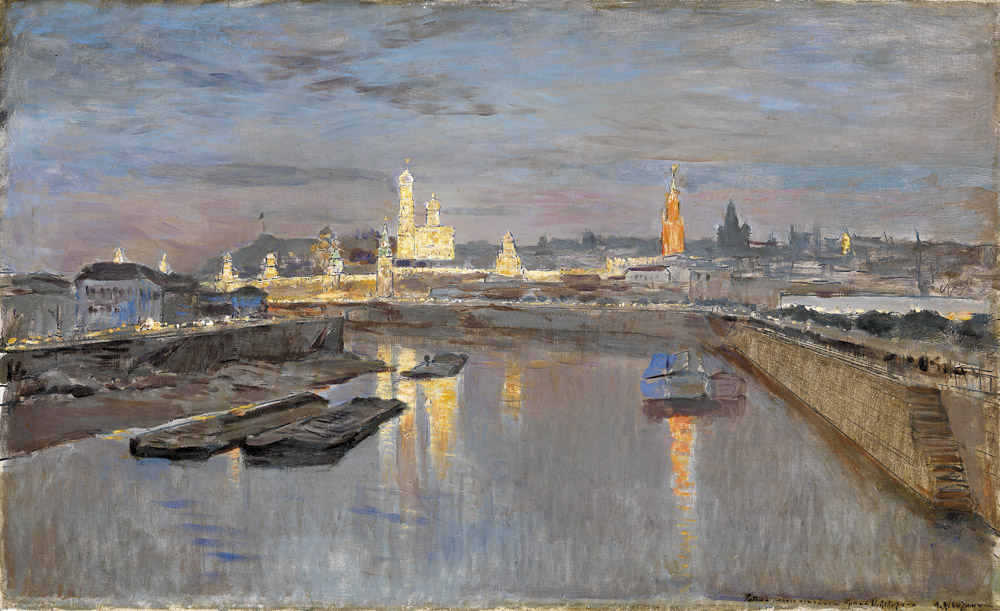
Isaak Levitan's "Illumination of the Moscow Kremlin
in the honor of Nicholas II"
|
In 1891, Alexander III appointed his brother Grand Duke Sergei Aleksandrovich to the governorship of Moscow. One of Grand Duke Sergei's first policies was to order removal from Moscow of all Jewish craftsmen, and later the order was expanded to include most categories of Moscow Jews, up to 20,000-30,000 people. (The statistics is a matter of some debate, since many Jews avoided official registration).
Samuel Vermel, a Moscow
doctor and a Jewish community leader, left copious notes about the way the Grand Duke's order was executed, citing official documents and personal anecdotes. I'm translating two anecdotes from his notes, published in a volume "Евреи в
Москве [Jews in Moscow]" (под редакцией Ю.Снопова и А.Клемперта, Москва:
Мосты Культуры; Иерусалим: Гешарим, 2003). His writing style is at
times effusive and passionate, with a heightened sense of tragedy (he compares the events in Moscow to the exile from Spain), but the details he provides are sharp and full of character.
The first story is a quick character sketch on the Grand Duke himself. "A Jewish electrician wired the Governor's mansion in Moscow. The job was performed handsomely and well. Grand Duke Sergei, inspecting the work in progress, expressed his pleasure. The electrician decided to speak up. "Your Imperial Highness," he said, "I'm not sure I'll be able to complete the work."
 |
| Grand Duke Sergei |
"Why not?"
"I'm a Jew, and I stand to be exiled from Moscow."
The Grand Duke, embarrassed, quickly recovered, "So hurry up to make it on time," he said, and quickly left the room."
The second story is far more upbeat, though it dates from the year 1894, during the height of Grand Duke Sergei's campaign against the Moscow Jewish community.
Vermel writes, "In 1894, during the International Medical Congress in Rome, the president of the Russian delegation, surgeon
Nikolai Vasilyevich Sklifosovsky, having secured the advance permission of the Russian government, asked to designate Moscow as the location of the next International Medical Congress. The French delegation accepted with delight, according to their temperament; the representatives of other countries were also glad of the opportunity to take a look at the "wild and barbarian Russia." Moscow's offer was accepted.
"The medical circles of Moscow began planning for this unprecedented event, excited to host the brightest stars of the medical science. But as the date of the Congress approached, "the Jewish question" unexpectedly entered the stage. As a matter of fact, Russian laws at the time prohibited all foreign Jews from entering the land. What to do? An International Medical Congress without the Jews was inconceivable. Jews were well represented in the medical profession, ranking high in quality and quantity, and included
Cesare Lombroso [an Italian criminal psychiatrist],
Hermann Senator [a German internist],
Emanuel Mendel [a German neurologist and psychiatrist],
Oscar Minkowski [remembered for his research on diabetes],
Paul Ehrlich [an immunologist who later became a Nobel Laureate], among others.
"The German medics, of whom a particularly large number wished to go to Moscow, raised the question of passage to Moscow well ahead of time and demanded an unequivocal answer. The president of the German organizing committee, a world-renowned scholar and politician
Rudolf Virchow ["the father of modern pathology"] demanded a clear-cut answer: yes or no.
 |
The new University of Moscow and
the Moscow Clinique,
images from The Lancet supplement,
printed for the Congress of 1897 |
"Grand Duke Sergei Aleksandrovich felt cornered and hesitated for a long time, refusing to commit one way or another. Sklifosovsky, at organizational meetings, exclaimed, "Ah, the pesky Jewish question!" The Grand Duke started haggling: he agreed to issue the foreign Jewish medics the permits to arrive and stay for two weeks. But Virchow decreed categorically: "If there will be any special conditions made for the Jews, no German medic will go to Moscow."
"And so Moscow authorities were forced to remove the Jewish question from the agenda and to establish "equal rights" between Jewish medics and medics of the other confessions.
"The Congress took place in August 1897; it was formally opened by the Grand Duke Sergei Aleksandrovich. It was one of the most spectacular and well attended International Medical Congresses, and Moscow saw within its walls a tremendous number of medical luminaries."


 Posts
Posts